

Washington's greenhouse gas inventory
The greenhouse gas inventory is the historical record of Washington’s contribution to global climate change. We publish an inventory report every two years, measuring the state's progress in reducing greenhouse gases compared to a 1990 baseline. This inventory helps us design policies to reduce greenhouse gas emissions and track progress toward meeting Washington's emission reduction limits. This estimate is based on data from the Washington Department of Commerce and Environmental Protection Agency (EPA).
Greenhouse gas inventories
Ecology data shows that Washington's greenhouse gas emissions increased the past three years:
- 2019 total emissions — 102.1 million metric tons
- 2018 total emissions — 95.5 million metric tons
- 2017 total emissions — 95.3 million metric tons
- Washington State Greenhouse Gas Emissions Inventory: 1990–2018
- Washington State Greenhouse Gas Emissions Inventory: 1990–2015
- Washington State Greenhouse Gas Emissions Inventory: 2012–2013
- Washington State Greenhouse Gas Emissions Inventory: 2010–2011
- Washington State Greenhouse Gas Emissions Inventory: 2009–2010
- Washington State Greenhouse Gas Emissions Inventory: 2007–2008
- Washington State Greenhouse Gas Emissions Inventory: 1990 baseline

2019 greenhouse gas sources, by sector
Greenhouse gas emissions for 2018 – 2019
New data on Washington's greenhouse gas emissions show emissions rose almost 7% in 2019 from 2018, reaching 102.1 million metric tons (MMT) of carbon dioxide equivalent (CO2e).
Transportation remains the largest contributor of greenhouse gas emissions in Washington showing a slight increase from 2018 to 2019 of less than 3%, or 4.8 MMT, reaching 40.3 MMT of CO2e. Overall, transportation's share of statewide emissions dropped from 44.9% in 2018 to 39% in 2019 while the share from the electricity sector increased.
Emissions from electricity generation grew almost 33% from 2018 to 2019. The greatest contributor to the 2018–2019 emissions increase is the mix of fuels used in the electricity sector. This sector’s emissions rose from 16.5 MMT CO2e in 2018 to 21.9 MMT CO2e in 2019, an increase of 5.4 MMT CO2e.
This year’s rise is in response to reduced availability of hydropower generation and a corresponding increase in fossil fuel generation to meet demand. However, 2020 data is available for the electricity sector, and it shows that 2020 emissions in this sector fell 35% to 14.2 MMT CO2e. This is 16% below the 1990 level (16.9 MMT CO2e) for this sector.
Sources of Washington greenhouse gases in 2019
Greenhouse gas reduction limits
Gov. Jay Inslee and the Washington State Legislature have secured new policies to reduce future greenhouse gas emissions. Because our greenhouse gas emissions inventory is based on past emissions, the impact of the new policies aren't reflected in the 2019 data. Examples of steps Washington is taking to cut emissions include:
- Switching the state to 100% clean electricity by 2045
- Raising standards for building energy efficiency
- Advancing zero emission vehicles
Despite the forecast for a 25% decline in emissions by 2030, Washington will still need to do more to reach the limits set by the Legislature that went into effect June 11, 2020:
- 2020 – Emissions fall to 1990 levels of 93.5 million metric tons
- 2030 – Emissions fall 45% below 1990 levels
- 2040 – Emissions fall to 70% below 1990 levels
- 2050 – Emission fall to 95% below 1990 levels – and the remaining 5% is offset
The limits were based on scientific recommendations about what cuts are necessary to prevent the worst effects of climate change on our state’s coastlines, water supplies, forests, environment, and economy.
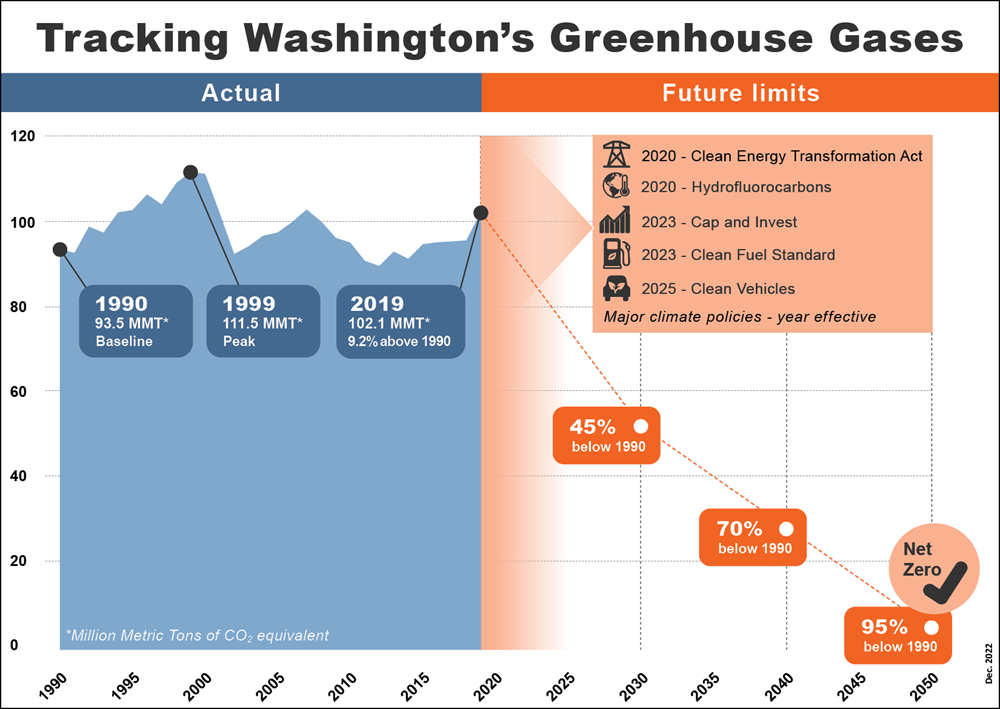
History of greenhouse gas emissions in Washington
Greenhouse gas emissions in Washington peaked in 1999, at just over 111 million metric tons. Since the Great Recession in 2008, emissions declined sharply for several years and have since slowly climbed back up. 2019's total emissions of 102.1 million metric tons are the highest level since 2007.