
Air Quality >
Agricultural Burning > Frequently Asked Questions
Frequently Asked Questions
1. Do I need a permit?
That depends on what type of burning you are doing.
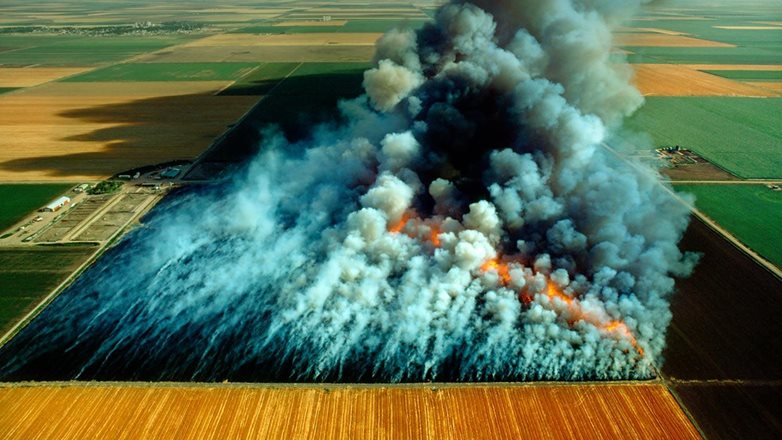
If you are burning for agricultural purposes, you will need a permit to burn any open field, harvest debris, or orchard trees being taken out of production.
Land clearing burning also requires a burning permit.
Land clearing burning means outdoor burning of trees, stumps, shrubbery, or
other natural vegetation from projects that clear the land surface so it can
be developed, used for a non-agricultural purpose, or left unused.
Other types of burning, such as fire training or habitat enhancement, may require
a special permit. For questions on permit requirements in Chelan, Kittitas,
Klickitat, Okanogan and Douglas counties contact the Department of Ecology's
Central Regional Office at (509) 454-7899.
For Adams, Asotin, Columbia, Ferry, Garfield, Grant, Ferry, Stevens, Pend Oreille, Walla Walla and
Whitman counties contact the Department of Ecology's Eastern Regional Office at (509) 329-3400.
For all other counties select here.
2. When can I burn?
If you are burning for agricultural purposes, and have an agricultural burn permit (orchard tear
out or field), you must burn on a designated burn day. You must call
1-800-406-5322 prior to burning. If the message for your area states that it
is a no-burn day, you may not legally burn. You must have an "OK" from
Ecology and your fire safety authority. If the message says it is a burn
day, you must still comply with your local fire protection agency's decision
if it determines it is a no-burn day. Compliance with burn bans put into
effect by another department/county/city is a specific condition of the
permit. The grower and local fire department are responsible for fire
safety.
3. Can I burn my yard waste?
Do you live in an Urban Growth Area (UGA)?
Residential and land clearing burning is not
allowed in UGAs in cities with a population of 10,000 or more. The only
outdoor burning allowed in UGAs is for the disposal of tumble weeds blown
by the wind, and recreational fires. Fires used for debris disposal are not
considered recreational fires. Agricultural burning can be allowed in UGAs.
To find out if out if you live in a UGA, please contact your local planning
department before burning. Local permits or restrictions might apply where
you live. Please contact your city or county before burning.
If you are nonagricultural, you can burn if you
are outside an urban growth area. The pile may be no bigger than 4'x4'x3'.
Always contact your local fire department.
4. How do I get publications?
You can download them off the internet or
contact The Department of Ecology.
Select this to go to Ecology's online publication index.
5. What is my alternative to burning, and is Ecology doing anything to promote alternatives?
For Local Recycling Facilities, select here.
For information on agricultural burning
Grants and Research, select here.
6. Who do I contact about a possible air quality problem in my neighborhood?
Visit our smoke complaint page.
7. Why is there a fee for agricultural burning permits?
When members of the Washington State Legislature passed the Clean Air Washington Act in 1991, they included
specific references to agricultural burning and fees that would be charged
to farmers who burn on their land. Specifically, the law says:
- The fee will cover the costs of the permitting program.
- The fee will provide funds for research into burning alternatives.
- The fee will not exceed $2.50 per acre (with allowance for inflation).
8. Who administers the agricultural burning permit program?
The law identifies parameters for delegating authority for agricultural burning programs to local county offices.
They include conservation districts, counties, fire protection authorities, Ecology and
Local Clean Air Agencies.
9. Who sets the permit fee amount?
The Agricultural Burning Practices and Research Task Force is charged with setting the fee. The fee
is based on a three-part equation: a portion dedicated to research, a state oversight portion and a local permit administration portion. The equation
was based on actual costs.
10. Where does the fee go?
Currently, Ecology has awarded
almost $400,000 of grant and research monies to various projects. All
this funding was acquired from permit fees. For a list of grant proposal,
go to Ecology's grants page.
11. What if I just have a small spot to burn?
If you are burning at your residence, see the
Outdoor Burning Focus Sheet.
If you are requesting to burn small spots on your farm, you need to complete a
Spot Burn Permit Application and pay a $25.00 fee for up to 10 acres of small
spots per year.
12. What is the current fee?
Ecology currently has a fee of $2.00 per acre, with a minimum of $25.00. Most of the permitting authorities
charge $2.00 an acre, but some are slightly less, depending on their administrative fee.
- $.50 an acre goes to research
- $.50-$1.25 goes to local administration
- Ecology oversight is $.25 an acre
13. Who are the current permitting authorities and how do I reach them?
| County |
Telephone Number |
| Adams |
509.659.1533 |
| Asotin |
509.758.8012 |
| Benton |
509.783.1304 |
| Columbia |
509.382.4741 |
| Franklin |
509.545.3521 |
| Garfield |
509.843.1998 |
| Grant |
509.754.0195 |
| Spokane |
509.477.4727 |
| Palouse CD |
509.332.4101 |
| Palouse Rock CD |
509.648.3680 |
| Whitman CD |
509.397.4636 |
| Walla Walla |
509.522.6340 |
| Yakima |
509.574.1410 |
| Pine Creek CD |
509.397.4636 |
| Chelan, Douglas, Okanogan, Kittitas, Klickitat |
509.575.2490 |
| Lincoln, Ferry, Stevens, Pend Oreille, |
509.329.3400 |
14. What is Township, Section, Range?
The US Public Land
Survey (USPLS) was used to survey and subdivide lands starting in
the 1800's. A standard "Township" is a 6 mile x 6 mile square
composed of 36 one mile square sections. The "Township" is defined
by a north or south Township number and an east or west Range number
from a set reference line. Note that "Township" refers both to the
north/south descriptor and the 6x6 unit described by a pair of
Township and Range descriptors. Due to original survey errors it is
not uncommon to have sections and Townships that are odd-shaped or
not quite standard size. If you are unfamiliar with the USPLS you
may contact your county Assessor's Office with your parcel number
(see your property tax statement) and they will be able to tell you
what your section, Township & Range description is.
Other Agricultural Links
Contact Us