
Political decision-makers, many water managers, and the general public usually have neither the time nor the training to study and understand a traditional, technical review of water quality data. A number of indexes have been developed to summarize and present water quality data in an easily expressible and easily understood format.
Ecology's stream monitoring Water Quality Index (WQI) was developed to address non-technical questions about general water quality. It is a unitless number ranging from 1 to 100; a higher number is indicative of better water quality relative to expectations.
For temperature, pH, fecal coliform bacteria, and dissolved oxygen, the index expresses results relative to levels required to maintain beneficial uses based on criteria in Washington’s Water Quality Standards, WAC 173-201A. For nutrient and sediment measures, where standards are not specific, results are expressed relative to expected conditions in a given region. Multiple parameters are combined and results aggregated over time to produce a single annual score for each sample station.
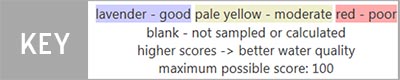
In general, stations scoring 80 and above met expectations for water quality and are of "lowest concern," scores 40 to 80 indicate "moderate concern," and water quality at stations with scores below 40 did not meet expectations and are of "highest concern."
Trying to evaluate and understand water quality from raw data can be confusing and frustrating to people not familiar with the terminology of water quality scientists. Even professionals may not know whether a particular result is high if they aren't familiar with the area where the sample was taken.
The WQI integrates complex water quality data into a readily understood scale to help the public and water managers better understand results from water quality monitoring. Indexes are particularly suited to comparisons (what stations have poor water quality compared to others?) and for general questions (how is water quality in my stream?). Providing WQI scores for complex data may also increase public awareness and understanding of water quality concerns.
Displayed on a map, the WQI can be used to identify geographic areas with water quality problems. The WQI also allows "drilling down" from the overall score to scores for individual parameters (what parameters are of particular concern?) and scores for individual months (during what months are problems most common?). The index can even be used to evaluate trends (is overall water quality getting better or worse?).
Once the user has a general understanding from the WQI of water quality at a location, they are encouraged to explore the raw data underlying the index. The raw data will provide a more complete picture, and the combination of the WQI and the raw data will help explain what all those numbers mean.
Results from any index should be used with caution for a number of reasons.
Our WQI indicates whether water quality was either poorer than expected or poorer than necessary to support beneficial uses at a particular location. There are disadvantages, however, to comparing results to expectations or beneficial use requirements. For one thing, this approach requires subjective determinations of the beneficial uses that a particular stream segment should support, the level of water quality required to support those uses, and how critical a variation from that level of quality is. For several key parameters, the first two of these determinations are already codified in Washington’s Administrative Code (WAC 173-201A). Another disadvantage is that, by design, the WQI indicates how well water quality at a station meets expectations but not how good the absolute quality is. Comparing WQIs for different stations does not indicate which station has the better absolute water quality unless expectations for both stations were the same.
The methodology used to determine WQI scores was originally developed by the Environmental Protection Agency (EPA), Region 10. Initial development was documented only in the "gray" literature, but the methodology is similar to and perhaps based on the well-known National Sanitation Foundation index. This index uses curves to relate concentrations or measurements of various parameters to index scores and then aggregates scores to a single number. The EPA curves were "a synthesis of national criteria, state standards, information in the technical literature, and professional judgment" (Peterson and Bogue, 1989). Washington's index is based largely on these curves, adjusted to reflect local water quality standards criteria. Procedures were modified in 2009 to accommodate the November 2006 amendment to the standards, including the addition of supplemental temperature standards during spawning seasons.
For complete information on the methodology, see A Water Quality Index for Ecology's Stream Monitoring Program.
We welcome comments on methodology (do the details make sense?), final outcome (are scores what they should be?), and presentation.
If you wish to determine index scores based on your own data, a spreadsheet version is available for download here.
Questions or comments on content or presentation may be sent to Dave Hallock.
Copyright © Washington State Department of Ecology. See http://www.ecy.wa.gov/copyright.html.