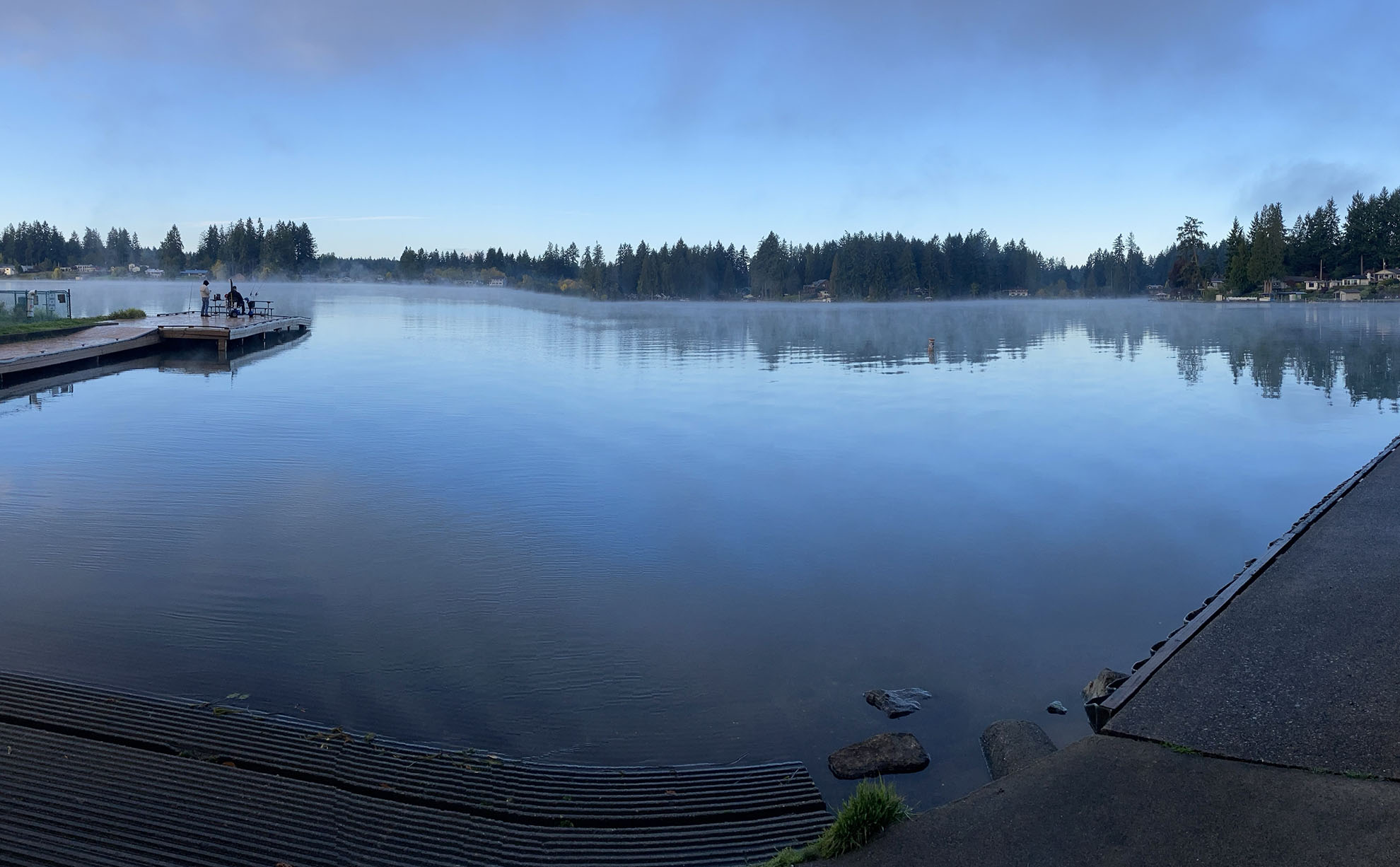
Thirty Washington lakes were randomly chosen as part of a group of more than 900 lakes nationwide to examine and report on the ecological health, water quality, and recreational value of the Nation’s lakes.
The U.S. Environmental Protection Agency funded the National Lakes Survey, and in Washington, Department of Ecology staff conducted the water quality sampling, habitat assessments, and other data collection.
The goal of the national lakes survey was to address two key questions about the quality of the Nation’s lakes, ponds, and reservoirs:
What percent of the Nation’s lakes are in
good, fair, and poor condition for key indicators of trophic state,
ecological health, and recreation?
What is the relative importance of key stressors such as nutrients, bacteria and lakeshore development?
The lake survey used a probability-based sampling design which will provide statistically valid estimates of the condition of all lakes that share similar physical characteristics. Individual lake assessments were not a goal; the program was not designed to address conditions at particular lakes.
Nationally, more than 900 lakes—representing five size classes and distributed evenly across the lower 48 states—were included in the survey. The lakes were selected randomly and included natural and man-made freshwater lakes, ponds, and reservoirs that were at least 3.3 feet deep and over 10 acres in size.
The thirty Washington lakes randomly selected for the survey ranged from 17-acre Lake Louise in Whatcom County to 7,600 acre Lake Ozette in the Olympic National Park.
The following water quality indicators were sampled at each lake:
Trophic Indicators
Lake profiles (pH, conductivity, temperature and dissolved oxygen)
Water quality chemistry and nutrient concentrations
Chlorophyll a, Secchi disk depth, turbidity, and color
Ecological Integrity Indicators
Sediment diatoms
Phytoplankton
Zooplankton
Shoreline physical habitat conditions
Macroinvertebrates (bugs)
Recreational Indicators
Pathogen indicator (enterococci bacteria)
Algal toxin (microcystins)
Sediment mercury
Data from the National Lakes Survey were compiled and analyzed by EPA and partnering agencies. The final national report is available at EPA’s National Lakes Assessment web site.
The Washington Department of Ecology wrote their own report analyzing the data collected from the thirty Washington lakes sampled as part of the national survey. This report presents the statewide status of lakes in terms of good, fair, and poor condition as well as evaluating which are the most important environmental stressors affecting Washington lakes. The final state report is available at http://www.ecy.wa.gov/biblio/1003029.html.
If you have any questions, please contact Maggie Bell-McKinnon.
For more information about the National Lakes Survey and Washington's role, contact Maggie Bell-McKinnon (360.407.6124).
Please send comments about or corrections to these pages to Dave Hallock (360.407.6681).
Copyright © Washington State Department of Ecology. See http://www.ecy.wa.gov/copyright.html.