
Size (acres) 346 Maximum Depth (feet) 85 Mean Depth (feet) 38 Lake Volume (acre-feet) 13148 Drainage Area (square miles) 317.00 Altitude (feet) 1096 Shoreline Length (miles) 6.0
Source of morphometric data: Water Supply Bulletins 42, 43, and 57.
VOLUNTEER-COLLECTED SECCHI DATA ________________________________________________________________________________________________________________________ Date Temperature Water %Cloud Recent Secchi Lake (Y/M/D) (C) (F) pH Color Cover Rain Wind (ft) Ht(in) Abbrev. Comments ________________________________________________________________________________________________________________________ STATION 1 96/05/22 0 9.3 0.0 FIELD VISIT 96/06/16 14.0 57.2 Mod Green 10 Calm 10.3 0.0 96/06/28 15.5 59.9 8.5 Undefined 10 None Breezy 10.0 0.0 96/07/16 22.0 71.6 8.5 Lt Green 10 None Light 9.2 0.0 96/08/21 0 13.2 0.0 FIELD VISIT 96/09/02 20.5 68.9 8.5 Undefined 10 None Light 11.4 0.0 ________________________________________________________________________________________________________________________
LABORATORY RESULTS ________________________________________________________________________________________________________________________ Total Total Fecal Col. Bacteria Turb- Suspended Solids Phosphorus Nitrogen Chlorophyll (colonies/100 mL) idity Total Non-Volatile Color Date Strata (ug/L) (mg/L) (ug/L) Site 1 Site 2 (NTU) (mg/L) (mg/L) (Pt-Co) ________________________________________________________________________________________________________________________ STATION 1 96/05/22 E 18 0.40 9.5J 10 38 2.1 96/05/22 H 31 0.60 96/08/21 E 21 0.32 5.4 1U 1U 1.6 96/08/21 H 113 0.90 ________________________________________________________________________________________________________________________ E=epilimnion composite, H=hypolimnion composite. Remarks codes: U = Below detection limits; J = Estimate.
SUMMARY OF VOLUNTEER SURVEY There was no survey response for 1996. FIELD OBSERVATIONS OF ECOLOGY STAFF Daphnia were abundant during spring sampling--the most ever seen in the field. There was a filamentous algal bloom observed during the summer field visit. Daphnia were observed at 10 meters. Hydrogen sulfide odor was detected at 15 and 20 meters.
TROPHIC STATUS Estimated Trophic State: Meso-eutrophic Mean Trophic State Index (Secchi): 43 (Mesotrophic) Mean Trophic State Index (Total Phosphorus): 48 (Meso-eutrophic) Mean Trophic State Index (Chlorophyll a): 56 (Eutrophic)
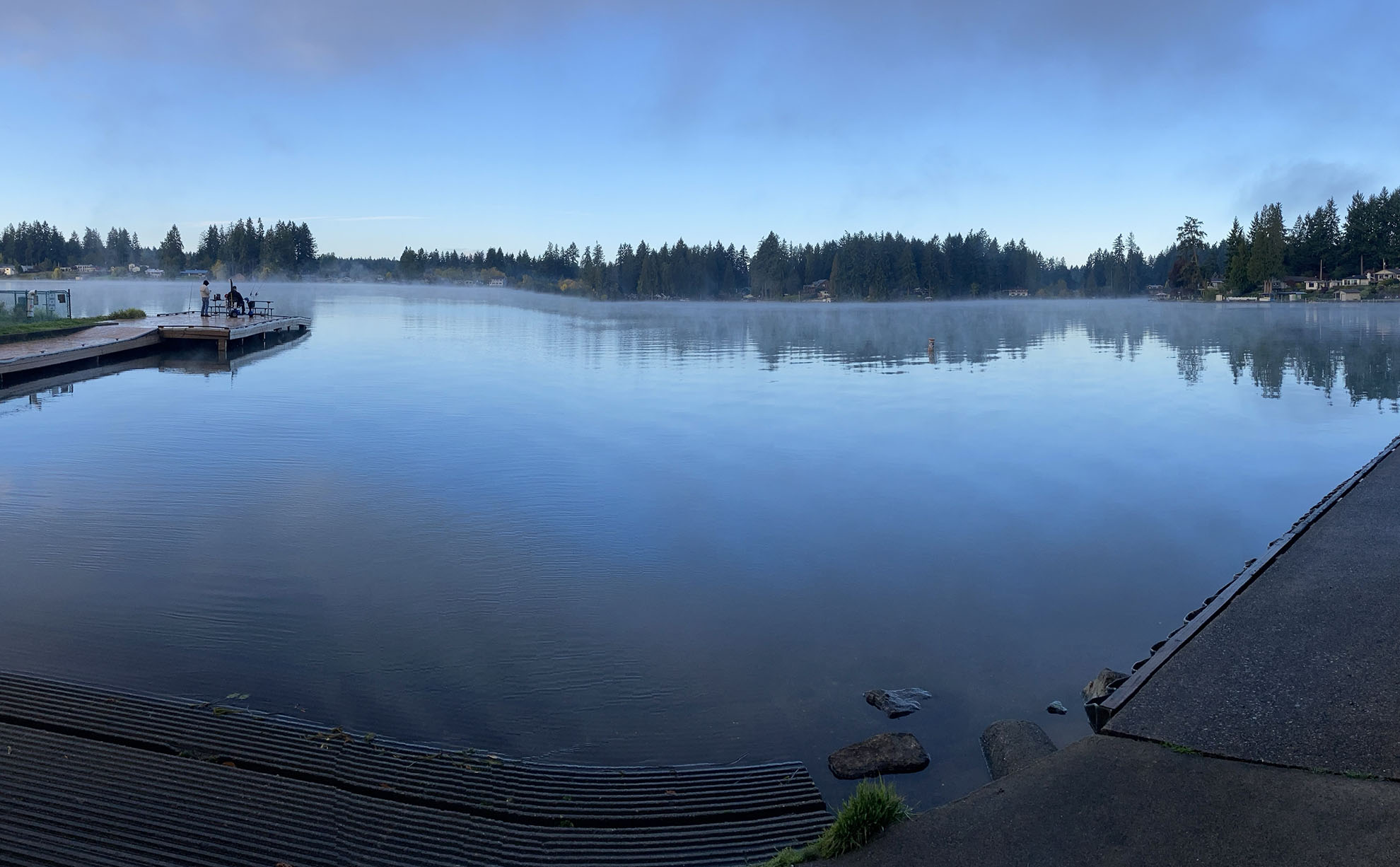
SUMMARY AND EXPLANATION OF TROPHIC STATE ASSESSMENT Park Lake is classified as eutrophic. Although TSI values might suggest a less eutrophic classification, summertime hypolimnion dissolved oxygen concentrations depict a 24 meter deep lake that is nearly anoxic below 8 meters. The degree of anoxia is indicative of an eutrophic lake.
COMMENTS FROM 98/09/10 AQUATIC PLANT SURVEY Sunny, calm. Surveyed most of shoreline - quickly passed road fill shoreline areas. Macrophyte community dominated by Chara, rooted plants mostly in the north end, with occasional individual plants elsewhere. Observed many geese, few ducks, fish - schools of black young catfish, a mink, a couple of turtles.
AQUATIC PLANT LIST (This list may be from multiple years and sources.) Ceratophyllum demersum (Coontail; hornwort) Chara sp. (muskwort) Juncus sp. or Eleocharis sp. (small grass-like plants) Lysimachia thyrsiflora (tufted loosestrife) Myriophyllum sibiricum (northern watermilfoil) Najas flexilis (common naiad) Phragmites communis (common reed) Polygonum amphibium (water smartweed) Potamogeton friesii (flat-stalked pondweed) Potamogeton pectinatus (sago pondweed) Potamogeton richardsonii (Richardson's pondweed) Potamogeton sp. (pondweed) Scirpus americanus (american bulrush) Scirpus sp. (bulrush) Scirpus tabernaemontani (softstem bulrush) Typha sp. (cat-tail) Vallisneria americana (water celery) Zannichellia palustris (horned pondweed) aquatic Bryophyte (moss or liverwort) unknown plant (unknown)
Go To:
Copyright © Washington State Department of Ecology. See http://www.ecy.wa.gov/copyright.html.