
Washington State Toxics Monitoring Program

May 2009
PBT Trend Monitoring: Lead in Suspended Particulate Matter, 2008
Older Toxics Monitoring Annual Reports

Contents

Introduction

Toxic contamination of our air, water, soil, and wildlife continues to be a concern in Washington State. Humans and wildlife face a variety of risks due to toxic chemicals in the environments. For many areas of Washington, information is lacking about the levels of toxic contaminants in freshwater fish and surface water. In 2000 Ecology developed the Washington State Toxics Monitoring Program to address these concerns.  The program goals are:

Exploratory Monitoring

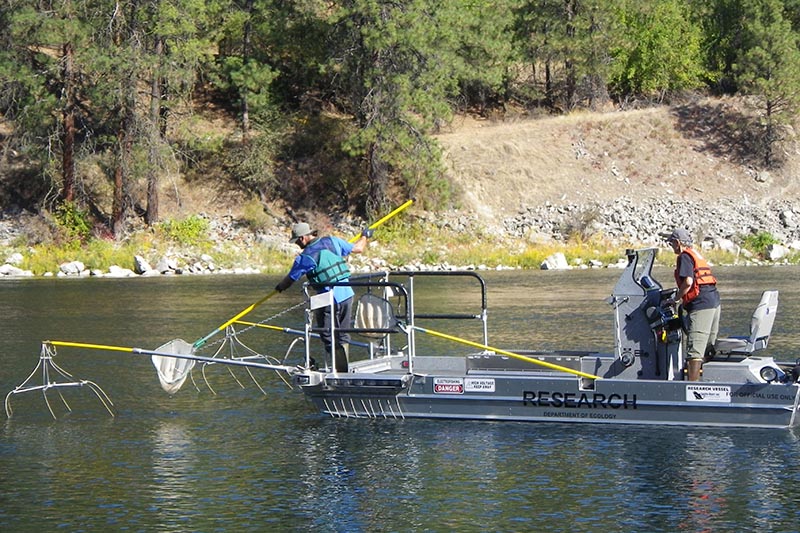
Since a monitoring plan was developed in 2001 the Exploratory Monitoring effort has collected over 230 fish tissue samples from more than 100 sites. Edible fish tissue from samples were analyzed for mercury, chlorinated pesticides, polychlorinated biphenyls (PCBs), polybrominated diphenyl ethers (PBDEs), polychlorinated dibenzo-p-dioxins and polychlorinated dibenzo-p-furans (PCDD and PCDFs), and lipids.

The goals of the exploratory monitoring effort are:

Sampling Locations

Fish Collection Sites for the Washington State Toxics Monitoring Program: 2001-2008.

Summary of sites, species, and analytes (Microsoft Excel format).

Target analytes and lab methods for fish tissue samples (Microsoft Excel format).

Results

2007 monitoring report

2006 monitoring report

2004-2005 monitoring report

2003 monitoring report

2002 monitoring report

2001 monitoring report

Study Data

Study data are available through Ecology's Environmental Information Management database. Results for different years can be accessed by entering "WSTMP" as the User Study ID.

Trend Monitoring - Lead in Suspended Particulate Matter

This project measures concentrations of lead in suspended particulate matter (SPM) from selected rivers and lakes in Washington. The goal is to establish a baseline for lead concentrations and to evaluate spatial and temporal trends over time. The project plan has more information http://www.ecy.wa.gov/biblio/0703104add1.html.

Results

PBT Trend Monitoring: Lead in Suspended Particulate Matter, 2008

Trend Monitoring - Mercury in Fish and Sediment

Mercury was chosen as the first pollutant to be addressed in the state's Persistent and Bioaccumulative Toxics Reduction Strategy.  A Mercury Chemical Action Plan was developed in 2003 by the Departments of Ecology and Health with assistance from an advisory committee representing business, health, environmental, and local government organizations.  Two monitoring efforts were developed to better understand mercury's behavior in the environment.

The goal of the fish tissue monitoring effort is to characterize temporal trends in mercury levels.  Target fish species for trend monitoring are bass and walleye.  See the project plan for more information.

The goal of the sediment monitoring effort is to evaluate mercury deposition across Washington by using age-dated sediment cores.  See the project plan and addendum for more information.

Results

Measuring Mercury Trends in Freshwater Fish in Washington State: 2007 Sampling Results

History of Mercury in Selected Washington Lakes Determined from Age-Dated Sediment Cores: 2007 Sampling Results

A Comparison of Two Analytical Methods for Measuring Mercury in Fish Tissue

Measuring Mercury Trends in Freshwater Fish in Washington State: 2006 Sampling Results

2006 Mercury in Sediment Core Results

2005 Mercury in Fish Results

Trend Monitoring - Organics in Water

The goal of this effort is to characterize temporal trends in organic contaminants in water from major rivers and lakes.  Initial compounds of interest are chlorinated pesticides, polychlorinated biphenyls (PCBs), and polybrominated diphenyl ethers (PBDEs).  Polycyclic aromatic hydrocarbons (PAHs) were added in 2008.  The project plan and addendum has more information.

Results

Trend Monitoring for Chlorinated Pesticides, PCBs, and PBDEs in Washington Rivers and Lakes, 2007