Ecology's PBT Initiative

Reducing and phasing out the “worst of the worst” chemicals for current and future generations.

One of Ecology’s strategic priorities is Reducing Toxic Threats. The PBT Initiative is a key part of this effort. It names the ‘worst of the worst’ toxic substances and suggests ways to reduce or remove the threat from them.

Persistent, bioaccumulative toxins (PBTs) are a distinct group of chemicals that threaten the health of people and the environment. Examples of PBTs include methylmercury, PCBs, DDT and dioxin. These types of toxic chemicals raise special challenges for our society and the environment because:
  • They are durable and remain in the environment for a long time without breaking down (persistent).
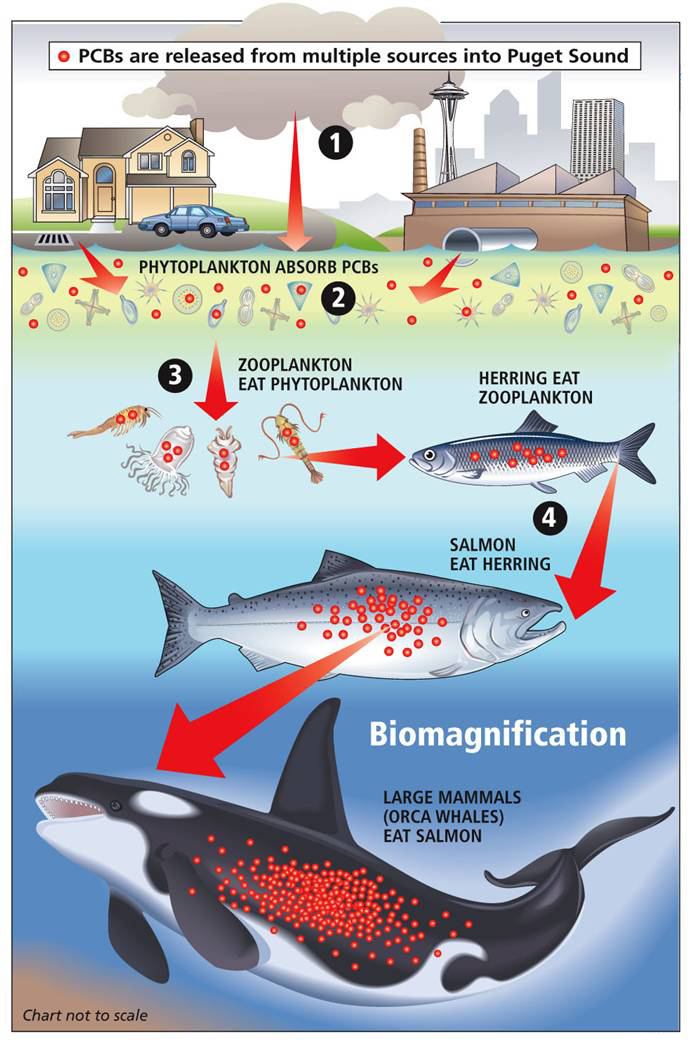
  • Animals and people accumulate PBTs in their bodies, primarily from the food they eat. As these chemicals move up the food chain, they increase in concentration, and linger for generations in people and the environment (bioaccumulate).
  • Exposure to PBTs has been linked to a wide range of toxic effects in fish, wildlife, and humans, including effects on the nervous system, reproductive and developmental problems, immune-response suppression, cancer, and endocrine disruption (toxic).
  • PBTs can travel long distances and generally move easily between air, water and land.
Some PBTs have been banned for more than 30 years, but their presence remains in land and water across the globe. For example, good cleanup technologies don’t yet exist for addressing PCB contamination in sediments and water. In Puget Sound, for example, the PCBs in sediment build-up in orca whales and other marine life. Another example is DDT, where residual levels remain in Washington soils more than 30 years after the pesticide DDT was banned by EPA.

Because of the unique threat that PBTs pose, Ecology developed a special project to deal with them. Ecology has been implementing the PBT Initiative since 2000.

The key elements of Ecology’s PBT Initiative are:
  • The PBT Rule (Chapter 173-333 WAC) This rule does not regulate toxic substances directly. It guides Ecology in setting its internal priorities to address PBTs. The rule:
    1. Contains the PBT List — chemicals defined as PBTs (the PBT List),
    2. Establishes procedures for developing Chemical Action Plans (CAPs),
    3. Lays out a process to prioritize and schedule future CAPs. CAPs (see below) are the main tools used to reduce or remove the threat from toxic substances.

  • The PBT List includes the ‘worst of the worst’. Substances were put on this list according to a selection process included in the PBT Rule. At this time, there are 27 substances on this list.

    Chemicals, Chemical Groups on the PBT List and the Metals of Concern List.
    Metals Flame Retardants Banned Pesticides Organic Chemicals
    Methyl-Mercury PBDEs
    Tetrabromobisphenol A
    Hexabromocyclododecane
    Pentachlorobenzene
    Aldrin/Dieldrin
    Chlordane
    DDT/DDD/DDE
    Heptachlor Epoxide
    Toxaphene
    Chlordecone
    Endrin
    Mirex
    1,2,4,5-TCB
    Perfluoro-octane sulfonates
    Hexachlorobenzene
    Hexachlorobutadiene
    Short-chain chlor paraffin
    Polychlrned Naphthalenes
    Combustion Byproducts Banned Flame Retardants Banned Organic Chemicals Metals of Concern
    PAHs
    PCDD
    PCDF
    PBDD/PBDF
    Hexabromobiphenyl PCBs Cadmium
    Lead


  • Chemical Action Plans (CAPs). A CAP is a study that 1) finds out where a specific PBT is coming from and 2) suggests ways exposure to it can be reduced or prevented. The PBT Initiative focuses on one toxic substance at a time. Ecology develops each CAP in collaboration with other agencies and experts representing various business, agricultural and advocacy sectors. For example, as part of the Mercury CAP (January 2003), Ecology worked with both the private and public sectors to set up a network for recycling mercury-containing thermostats.

  • The Multiyear CAP Schedule gives Ecology, in consultation with the Department of Health (DOH), a method for choosing the order it will do CAPs in the future. Ecology’s current CAP schedule has a timeline through 2010 (see below).

PBT Initiative History:

  • In December 2000, at the direction of the Washington State Legislature, Ecology proposed a PBT reduction strategy. The Legislature also directed and provided funding to Ecology to develop a chemical action plan (CAP) for mercury. Ecology teamed up with the Washington State Department of Health (DOH) for this effort and Ecology and DOH completed the Mercury Chemical Action Plan in January 2003.
  • In January 2004, then Governor Gary Locke issued Executive Order 04-01. This Executive Order directed Ecology and DOH to develop a CAP for a group of brominated flame retardants known as polybrominated diphenyl ethers (PBDEs). Ecology and DOH completed the PBDE CAP in January 2006.
  • Additionally, Executive Order 04-01 and the 2004 Legislature (House Bill 2459) directed Ecology to develop a PBT [regulation] rule. Ecology adopted the PBT Rule in February 2006.
In early 2007, Ecology finalized its schedule of CAP development (link to Ecy Pub # 07-07-016) for the next three years. This schedule is as follows:

PBT Chemical CAP Development Schedule
Lead.
A naturally occurring metal, lead is a powerful neurotoxin. Until it was banned as an additive, lead was used widely in gasoline and house paint. Lead continues to be used widely in manufacturing.
March 2007 – March 2008
Polycyclic aromatic hydrocarbons (PAHs).
PAHs are a group of more than 100 different chemicals. Some occur as a by product of the burning of organic substances like coal, oil, gas or garbage and end up as soot. Some PAHs are manufactured and are used to make products ranging from roofing tar to medicines, from plastics to pesticides. Animal studies have linked PAHs to reproductive problems and weakened immune systems.
March 2008 – March 2009
Perfluorooctane sulfonates (PFOS).
PFOS and their chemical variations were used historically as water, oil, soil and grease repellents for carpets, fabric and upholstery and food packaging, and in specialized applications such as fire-fighting foams, aviation hydraulic fluids, and insecticides.
March 2008 – March 2010


Ecology and DOH are currently developing a CAP for Lead. For information on the Lead CAP development effort, please visit the Lead CAP web site.

For further information, contact:

Mike Gallagher
Ecology PBT Coordinator
Solid Waste & Financial Assistance Program
Department of Ecology
PO BOX 47600
Olympia, WA 98504-7600


Phone: (360) 407-6868
Email: MGAL461@ecy.wa.gov


PBT Rule

PBT List

Multiyear CAP Schedule

Mercury CAP

PBDE CAP

Lead CAP