|
Description of Method
Aquatic
herbicides are chemicals specifically formulated for use in water to kill or
control aquatic plants. Herbicides approved for aquatic use by the United
States Environmental Protection Agency (EPA) have been reviewed and are
considered compatible with the aquatic environment when used according to
label directions. However, some individual states, including
Washington, also impose additional constraints on their use.
Aquatic
herbicides are sprayed directly onto floating or emergent aquatic plants or
are applied to the water in either a liquid or pellet form. Systemic
herbicides are capable of killing the entire plant. Contact
herbicides cause the parts of the plant in contact with the herbicide to
die back, leaving the roots alive and able to regrow. Non-selective,
broad spectrum herbicides will generally affect all plants that they come in
contact with. Selective herbicides will affect only some plants
(often dicots - broad leafed plants like Eurasian watermilfoil (Myriophyllum
spicatum) will be affected by selective herbicides whereas monocots like
Brazilian elodea (Egeria densa) may not be affected). Most aquatic
plants are monocots.
Because of
environmental risks from improper application, aquatic herbicide application
in Washington state
waters is regulated and has the following restrictions:
-
Applicators must be licensed by the Washington State Department of
Agriculture.
-
Because of a March 2001 court decision (federal 9th Circuit District
Court), coverage under a discharge permit called a National Pollutant
Elimination System Discharge (NPDES) permit must be obtained before
aquatic herbicides can be applied to the waters of the state.
-
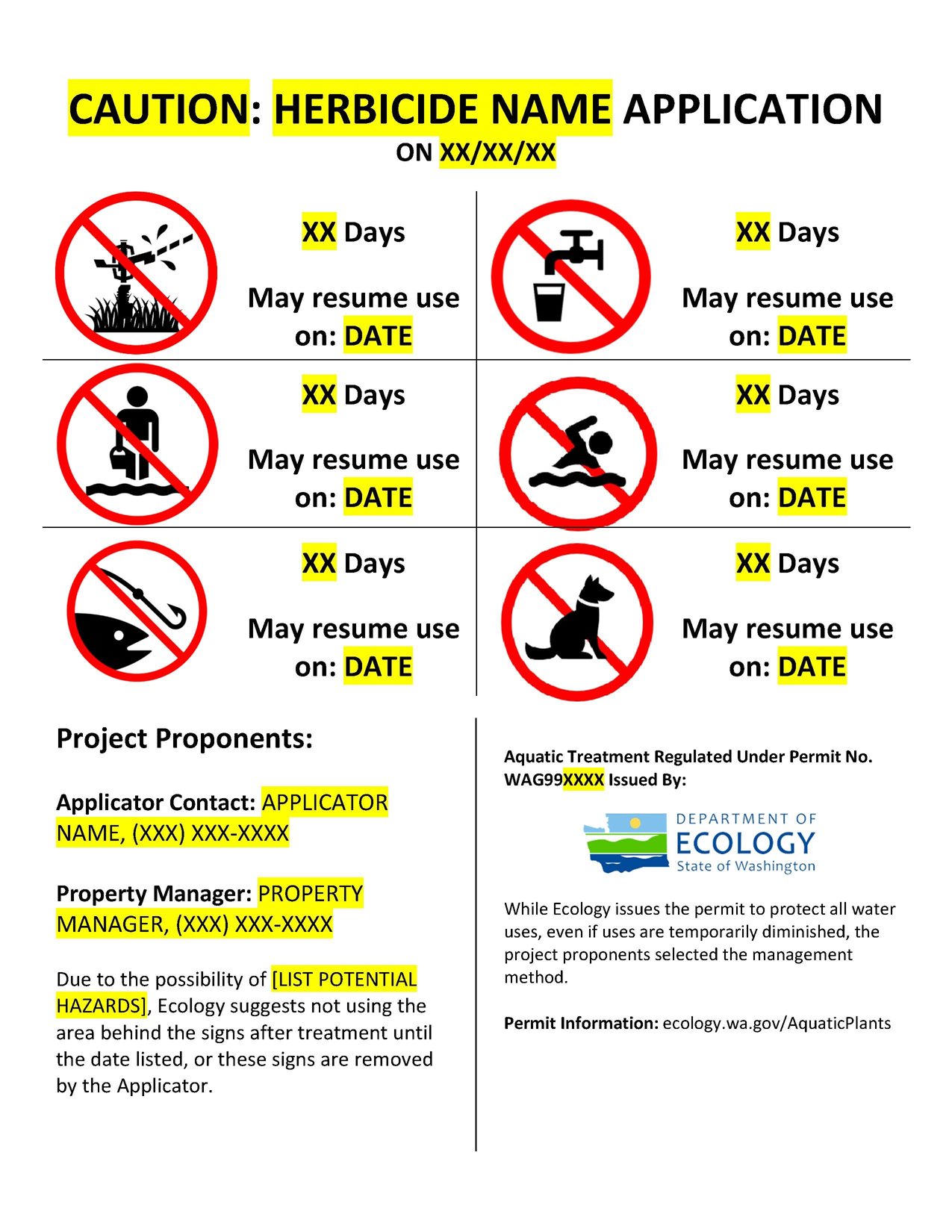
Notification and posting are required and there may be additional
mitigations proposed to protect rare plants or threatened and endangered
species.
Ecology issued a "lake" NPDES general permit March
1, 2006 to cover the management of in-lake noxious weeds and native aquatic plants and algae.
The Washington Department of Agriculture also has
a general NPDES permit for the management of noxious weeds growing
in wet areas such as freshwater wetlands, rivers, and estuaries.
Click here for more information about these
permits. For
in-lake projects applicators and/or the local government sponsoring the project must obtain
coverage under Ecology's Aquatic Plant and Algae Management NPDES permit before applying herbicides. For
non-lake projects involving the treatment of noxious weeds in wet areas and
estuaries, government sponsors and other entities can obtain coverage under the
Washington Department of Agriculture's NPDES permit for noxious weed control.
Click here to apply for coverage under the
Agriculture's permit via the internet.
Ecology currently issues permits for seven aquatic herbicides
and two algaecides (as of 2006 treatment season) for aquatic plant treatment
for lakes, rivers, and streams. Plant control in irrigation canals is covered
under another permit.
The chemicals that are permitted for use in
2006 are:
Aquatic Herbicides
-
Glyphosate
- (Trade names for aquatic products with glyphosate as the active
ingredient include: Rodeo®, AquaMaster®, and AquaPro®). This systemic
broad spectrum herbicide is used to control floating-leaved plants like
water lilies and shoreline plants like purple loosestrife. It is generally
applied as a liquid to the leaves. Glyphosate does not work on underwater
plants such as Eurasian watermilfoil. Although glyphosate is a broad
spectrum, non-selective herbicide, a good applicator can somewhat
selectively remove targeted plants by focusing the spray only on the
plants to be removed. Plants can take several weeks to die and a repeat
application is often necessary to remove plants that were missed during
the first application.
-
Fluridone
– (Trade names for fluridone products include: Sonar® and Avast!®).
Fluridone is a slow-acting systemic herbicide used to control Eurasian
watermilfoil and other underwater plants. It may be applied as a pellet or
as a liquid. Fluridone can show good control of submersed plants where
there is little water movement and an extended time for the treatment. Its
use is most applicable to whole-lake or isolated bay treatments where
dilution can be minimized. It is not effective for spot treatments of
areas less than five acres. It is slow-acting and may take six to twelve
weeks before the dying plants fall to the sediment and decompose. When
used to manage Eurasian watermilfoil in Washington, fluridone is applied
several times during the spring/summer to maintain a low, but consistent
concentration in the water. Some new granular formulations of fluridone
are proving to be effective when treating areas of higher water
exchange. Although fluridone is considered to be a broad
spectrum herbicide, when used at very low concentrations, it can be used
to selectively remove Eurasian watermilfoil. Some native aquatic plants,
especially pondweeds, are minimally affected by low concentrations of
fluridone.
-
2,4-D
– There are two formulations of 2,4-D approved for aquatic use. The
granular formulation contains the low-volatile butoxy-ethyl-ester
formulation of 2,4-D (Trade names include: AquaKleen® and Navigate®). The
liquid formulation contains the dimethylamine salt of 2,4-D (Trade name -
DMA*4IVM). 2,4-D is a relatively fast-acting, systemic, selective
herbicide used for the control of Eurasian watermilfoil and other
broad-leaved species. Both the granular and liquid formulations can be
effective for spot treatment of Eurasian watermilfoil. 2,4-D has been
shown to be selective to Eurasian watermilfoil when used at the labeled
rate, leaving native aquatic species relatively unaffected. (Click
here to read Ecology’s risk assessment). By court-order the butoxy-ethyl-ester
formulation of 2,4-D can not be used in salmon-bearing waters in the
Pacific Northwest.
-
Endothall - Dipotassium Salt
– (Trade name Aquathol®) Endothall is a fast-acting non-selective contact herbicide which
destroys the vegetative part of the plant but generally does not kill the
roots. Endothall may be applied in a granular or liquid form. Typically
endothall compounds are used primarily for short term (one season) control
of a variety of aquatic plants. However, there has been some recent
research that indicates that when used in low concentrations, endothall
can be used to selectively remove exotic weeds; leaving some native
species unaffected. Because it is fast acting, endothall can be used to
treat smaller areas effectively. Endothall is not effective in controlling
Canadian waterweed (Elodea canadensis) or Brazilian elodea. (Click
here to read Ecology’s risk assessment for endothall)
-
Diquat
– (Trade name Reward®). Diquat is a fast-acting non-selective contact
herbicide which destroys the vegetative part of the plant but does not
kill the roots. It is applied as a liquid. Typically diquat is used
primarily for short term (one season) control of a variety of submersed
aquatic plants. It is very fast-acting and is suitable for spot treatment.
However, turbid water or dense algal blooms can interfere with its
effectiveness. Diquat was allowed for use in Washington in 2003 and
Ecology collected information about its efficacy against
Brazilian elodea in 2003. A littoral zone treatment in Battle Ground Lake
in Clark County Washington in 2003 resulted in nearly complete removal of
Brazilian elodea in that water body. (Click
here to read Ecology’s risk assessment for diquat).
Click here to read the
journal article about the Battle Ground Lake study.
-
Triclopyr
- (Trade name Renovate3®). There are two formulations of triclopyr. It is
the TEA formation of triclopyr that is registered for use in aquatic or
riparian environments. Triclopyr, applied as a liquid, is a relatively
fast-acting, systemic, selective herbicide used for the control of
Eurasian watermilfoil and other broad-leaved species such as purple
loosestrife. Triclopyr can be effective for spot treatment of Eurasian
watermilfoil and is relatively selective to Eurasian watermilfoil when
used at the labeled rate. Many native aquatic species are unaffected by
triclopyr. Triclopyr is very useful for purple loosestrife control since
native grasses and sedges are unaffected by this herbicide. When applied
directly to water, Ecology has imposed a 12-hour swimming restriction to
minimize eye irritation. Triclopyr received its aquatic registration from
EPA in 2003 and was allowed for use in Washington in 2004. (Click
here to read Ecology's EIS for triclopyr)
-
Imazapyr
- (Trade name Habitat®). This systemic broad spectrum, slow-acting herbicide, applied as a liquid, is used to control emergent plants like spartina,
reed
canarygrass, and phragmites and floating-leaved plants like water lilies.
Imazapyr does not work on underwater plants such as Eurasian watermilfoil.
Although imazapyr is a broad spectrum, non-selective herbicide, a good
applicator can somewhat selectively remove targeted plants by focusing the
spray only on the plants to be removed. Imazapyr was allowed for use in
Washington in 2004. (Click
here to read Agriculture's risk assessment for imazapyr)
Adjuvants
Algicides
-
Endothall - Amine Salt
–
(Trade name Hydrothol 191®) Hydrothol 191® is a rapidly acting
non-selective contact herbicide or algicide. In Washington Hydrothol 191®
may only be used at very low concentrations for filamentous algae control
or cyanobacteria control (blue-green algae) in selected waterbodies. Several treatments each season may be needed to
control algae/cyanobacteria. Hydrothol 191® has a high acute toxicity to fish and must
be used with extreme care. Because of fish impacts, concentrations higher
than 0.2mg a.e./L of Hydrothol 191® are not be allowed. Unlike copper
compounds that are also used for algae control, Hydrothol 191® does not
accumulate in sediments and breaks down rapidly. There are water use
restrictions associated with the use of Hydrothol 191® in Washington. (Click
here to read Ecology’s risk assessments)
-
Peroxygen-based Granular
Algaecide - (Trade name
GreenClean®) GreenClean® is a peroxygen-based granular algaecide used for
the prevention and control of algae in ponds, streams, irrigation systems,
ornamental pools, and fountains. Areas being treated with GreenClean® must
be closed to recreational activities during and for two-hours after
treatment.
-
Copper Compounds
- Copper compounds are no longer allowed for aquatic use in Washington
state waters except under the NPDES permit for Irrigation Districts.
Advantages
-
Aquatic herbicide application can be less expensive than other
aquatic plant control methods, especially when used in controlling
wide-spread infestations of state-listed noxious aquatic weeds.
-
Aquatic herbicides are easily applied around docks and underwater
obstructions.
-
Washington has had some success in
eradicating Eurasian watermilfoil, a state listed noxious weed, from some
smaller lakes (350 acres or less) using fluridone products.
-
2,4-D, particularly the liquid formulation, has been shown to be effective in controlling smaller
infestations of Eurasian watermilfoil in Washington.
Disadvantages
-
Some herbicides have swimming, drinking, fishing, irrigation, and
water use restrictions (check the label and general permit).
-
Herbicide use may have unwanted impacts to people who use the water
and to the environment.
-
Non-targeted plants as well as nuisance plants may be controlled or
killed by some herbicides.
-
Depending on the herbicide used, it may take several days to weeks
or several treatments during a growing season before the herbicide
controls or kills treated plants.
-
Rapid-acting herbicides like endothall and diquat may cause low
oxygen conditions to develop as plants decompose. Low oxygen can cause
fish kills.
-
To be most effective, generally herbicides must be applied to
rapidly-growing plants.
-
Some expertise in using herbicides is necessary in order to be
successful and to avoid unwanted impacts.
-
Many people have strong feelings against using chemicals in water.
Find out what your neighbors think about chemical use before deciding to
treat your water plants with herbicides.
-
Some cities or counties may have policies forbidding or discouraging
the use of aquatic herbicides. Check before hiring an aquatic herbicide
applicator.
Permits
A NPDES permit is needed to apply any aquatic pesticide
(including herbicides) to waters of the state. Some herbicide residue monitoring may
be required and there is a permit fee for coverage under the Aquatic Plant
and Algae Management permit.
For aquatic plant or algae management in lakes
(includes both noxious weeds and native plants and algae) apply to Ecology
for coverage.
Ecology
in-Lake Aquatic Plant and Algae
Permitting Contact
For
noxious weed control in
wet areas, estuaries, rivers, and lake shorelines (only)
apply to the Washington Department of Agriculture for coverage under their
NPDES permit each treatment season. There is no permit or application fee to
obtain coverage under Agriculture's permit. However, the targeted weeds must
be on the Washington’s Noxious Weed List or on Agriculture’s quarantine
lists.
Click here to apply on-line for coverage under Agriculture's permit.
Ecology Noxious Weed
Permitting Contact
Department of Agriculture
Noxious Weed Permitting Contacts
| Noxious Freshwater Emergents
(Yakima) |
Greg Haubrich
Phone: (509) 225-2604
E-mail: ghaubrich@agr.wa.gov
|
| Spartina (Olympia) |
Kyle Murphy
Phone: (360) 902-1923
E-mail: KMurphy@agr.wa.gov
|
| General Information about the
Application (Olympia) |
Eloise Rudolph
Phone: (360) 902-2070
E-mail: ERudolph@agr.wa.gov |
Costs
of Herbicide Treatment
Approximate
costs for one acre herbicide treatment:
-
Glyphosate: $250
-
Fluridone: $900 to $1,000
-
Endothall: $650
-
2,4-D: $600
-
Diquat: $300 to $400
These costs
are estimates and will vary from site to site depending on treatment rates, water depths,
amount of notification needed, difficulty of access to the site, and other
factors.
Click here to read about an innovative
approach to using aquatic herbicides
Home
| Manual Methods | Bottom Screens | Grass Carp | Cutting
| Harvesting | Rotovation | Diver Dredging | Drawdown | Weed
Rolling | Aquatic Herbicides
| Biological Control
Return to Aquatic Plants and
Lake Page
Questions about
this page?
Contact Kathy Hamel by e-mail at kham461@ecy.wa.gov
Last Updated
May 05, 2008
|