Hangman Creek multi-parameter TMDL
Hangman Creek is a major tributary of the Spokane River that originates in the mountains of Idaho and flows northwest toward its confluence with the Spokane River. Hangman Creek and its tributaries are listed among the state's polluted waters. The creek once teemed with native salmon and Redband Trout (a subspecies of Rainbow trout) but urbanization, agriculture, and deforestation have taken a toll on water quality, riparian, and aquatic habitats. Protecting and restoring the Hangman Creek watershed is important to the Upper Columbia Plateau Tribes, local, state and federal agencies, landowners, conservation organizations, and many Washington residents who are working together to clean up the watershed.
Why is clean water important?
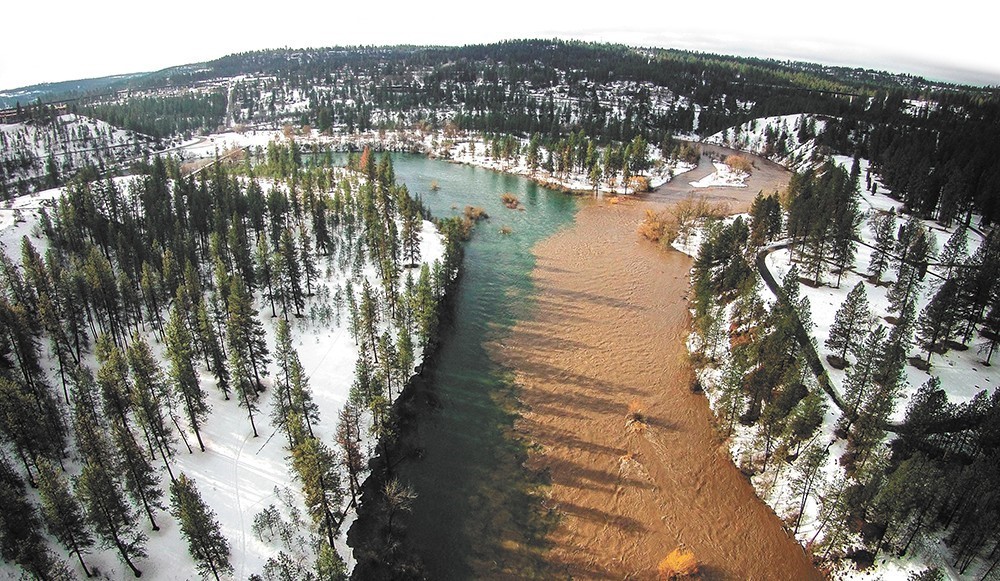
During times of rain or snowmelt, brown water flows from Hangman Creek into the Spokane River. These flows contain heavy sediment, nutrients, and bacteria, which can lead to algae blooms.
Keeping the watershed clean is important because high levels of bacteria increase risk to people swimming, wading, or fishing. Heavy sediment flows choke fish nests (called redds) and contain excess nutrients which contribute to algae blooms and other water quality problems downstream in the Spokane River and Lake Spokane. When algae decomposes, it uses up oxygen, potentially stressing fish. High temperatures create poor habitat conditions for fish and other aquatic life.
Streams in the Hangman Watershed do not meet clean water requirements according to our water quality assessment. The watershed contributes a high amount of sediment and nutrients, such as phosphorus, into downstream waterbodies. The Hangman Watershed is the largest source of phosphorus to the Spokane River. Issues such as streambank erosion, riparian vegetation loss, agricultural and forestry practices, and stormwater runoff are major concerns.
Problems include:
- High temperature and bacteria, and pH
- Low dissolved oxygen
- Too much sediment in the water (turbidity)
- High nutrient levels like phosphorus and nitrogen
Our water cleanup plan
Water cleanup plans are required for each waterbody on the state’s polluted waters list. We worked with the Spokane Conservation District to study Hangman Creek and develop a cleanup plan, also called a Total Maximum Daily Load (TMDL) report, which evaluated sources of pollutants. Also, in 2011 we developed an Implementation Plan that outlines strategies to guide the cleanup. The Environmental Protection Agency (EPA) approved the water cleanup plan in 2009.
What we are doing
We are working with key partners, including tribes, conservation organizations, and local agencies, to implement the Hangman Creek water cleanup plan and continue to understand and address sources of pollution in the watershed. We are working together to address sources of pollution in order to create habitat for Redband Trout and other species, and ensure safe swimming, fishing, and boating.
Learn more about Hangman Creek restoration in this Spokane River Forum video.
Farming and Ranching
Polluted runoff from agricultural, forestry, and urban sources, called “nonpoint” pollution, contributes the majority of the pollution in the watershed. One way we protect and improve water quality is by restoring riparian areas, a transitional zone between a waterbody and land. Riparian vegetation acts as a natural buffer to protect streams, rivers and lakes from nonpoint pollution. Along with our partners, we restore riparian areas by planting native vegetation to improve stream health and create habitat for important aquatic species, like the Redband Trout, and ensure safe swimming, fishing, and boating. We also encourage widespread use of conservation tillage techniques (i.e. direct seed) and other agricultural practices to protect water quality by reducing runoff and erosion.
Watershed Evaluations
We perform annual watershed evaluations within the Hangman Watershed to prioritize sites for agricultural best management practices (BMP) implementation and riparian restoration. We evaluate livestock grazing and dryland agriculture impacts to streams and identify site condition that cause, or have the potential to cause, pollution to surface or ground water. We contact landowners to offer technical and financial assistance and partner with local organizations, like conservation districts, to design and implement projects that eliminate the pollution.
Related links
- Hangman Creek improvement report for fecal coliform, temperature, and turbidity
- Hangman Creek implementation plan for fecal coliform, temperature, and turbidity
- Hangman Creek project plan for dissolved oxygen, pH, and nutrients
- Tekoa Wastewater Treatment Plant Dissolved Oxygen, pH, and Nutrients Receiving Water Study
- Ecology and the Spokane Riverkeeper settlement agreement
Contact information
Mitch Redfern
Water Quality Implementation Lead
mitch.redfern@ecy.wa.gov
509-329-3534