

Salish Sea Model
The Salish Sea Model was developed by Pacific Northwest National Laboratory (PNNL) in collaboration with scientists within our Environmental Assessment Program. The model is a powerful computerized tool that has algorithms within it to simulate hydrodynamic and water quality processes.
We have invested several years of time and research into developing and applying the model and will soon use it to help guide management actions that are needed to protect water quality in Puget Sound. Model scenarios can be run to evaluate the relative effect of current, anthropogenic, and potential future nutrient loads on dissolved oxygen and acidification levels in the Salish Sea.
Model description
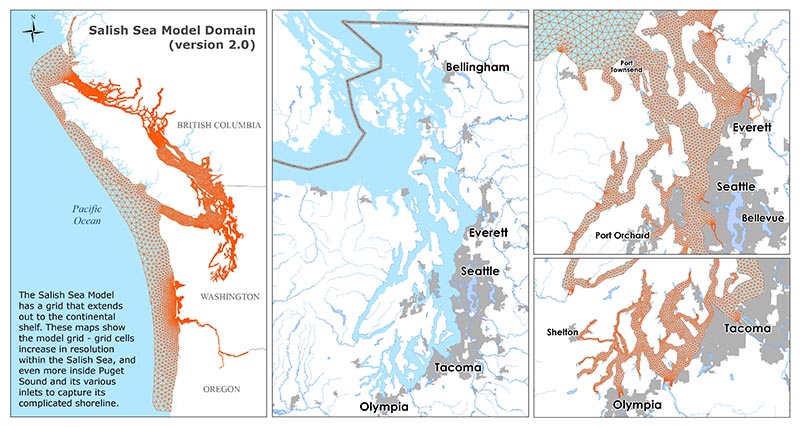
The Salish Sea Model is a powerful three-dimensional computer tool that can simulate hydrodynamic and water quality processes in the Salish Sea. It is a scientific and engineering tool that can be used to guide management actions that are needed to protect water quality in Puget Sound and to plan for future conditions.The model domain includes all of Puget Sound, the Strait of Juan de Fuca, and the Strait of Georgia, as well as inputs from 64 rivers and streams and 99 facilities/point sources (mostly municipal wastewater treatment plants) in the U.S. and Canada.
The model grid is represented with triangular cells that have higher resolution/smaller triangles in the inlets, bays, and narrower regions of Puget Sound, and coarser resolution/larger triangles in the Straits. It has 10 vertical layers, with thinner layers at the surface and thicker layers at depth. The model currently includes the following simulated features:
- Hydrodynamics — Circulation, currents, water temperature, and salinity using an unstructured grid under the Finite Volume Coastal Ocean Model (FVCOM) framework.
- Water quality — Including a total of 19 state variables, two species of algae, dissolved and particulate carbon, and nutrients, using biogeochemical water quality kinetics from the integrated compartment model (CE-QUAL-ICM).
- Sediment diagenesis — Fluxes of nitrogen, phosphorus, and carbon between the sediment and water column.
- Acidification — pH, aragonite saturation state, and related carbonate system parameters.
Why do we need a model?
Computer models are powerful tools which scientists and engineers use to represent water quality processes and predict responses to changes or management actions. The Salish Sea Model allows us to run virtual experiments that we cannot do in real life. For example, the Salish Sea Model can be used to assess how water quality might change under different scenarios, e.g., an increase in air temperatures or changes in river flows due to climate change, or a reduction in nutrient loading by removing human sources of nitrogen entering the Salish Sea. Model results from different scenarios can be compared to help identify what actions need to be taken to improve or protect water quality.
We are using the Salish Sea Model to answer the following key questions:
- What are the relative impacts on dissolved oxygen and pH levels from human nutrient loads, Pacific Ocean conditions, and climate change?
- Are human sources of nutrients in and around the Salish Sea significantly impacting water quality?
- How much do we need to reduce human sources of nutrients to protect water quality in the Salish Sea?
Model status and documentation
The table below outlines the work that has been done to date and includes related publications. The model has primarily been calibrated to 2006 water quality conditions, though more recently we have also used it to simulated conditions in 2008, and are beginning to model 2014 conditions as well. Also note that previous publications and reports have referred to this model as the "Puget Sound Dissolved Oxygen Model" and the "Puget Sound Georgia Basin Model."
|
Year |
Publication |
Reference/Link |
|---|---|---|
|
2009 |
Quality Assurance Project Plan for Puget Sound Dissolved Oxygen Modeling Study |
Sackmann, 2009 |
|
2010 |
Puget Sound Dissolved Oxygen Modeling Study: Development of an Intermediate Scale Hydrodynamic Model |
Yang et al., 2010 |
|
2011 |
Development of nutrient loading estimates from point and nonpoint sources into the Salish Sea. |
Mohamedali et al., 2011 |
|
2012 |
Puget Sound Dissolved Oxygen Modeling Study: Development of an Intermediate Scale Water Quality Model |
Khangaonkar et. al., 2012 |
| 2012 | Simulation of annual biogeochemical cycles of nutrient balance, phytoplankton bloom(s), and DO in Puget Sound using an unstructured grid model | Khangaonkar et. al., 2012 |
|
2014 |
Sound and the Straits Dissolved Oxygen Assessment: Impacts of Current and Future Human Nitrogen Sources and Climate Change through 2070 (Note: this version of the model did not include sediment diagenesis) |
|
| 2014 | Approach for Simulating Acidification and the Carbon Cycle in the Salish Sea to Distinguish Regional Source Impacts | Long et al., 2014 |
| 2015 | Quality Assurance Project Plan: Salish Sea Dissolved Oxygen Modeling Approach: Sediment-Water Interactions | Roberts et al., 2015 |
|
2017 |
Addition of Sediment Diagenesis Module to the Salish Sea model | |
|
2017 |
Addition of Ocean Acidification Module to the Salish Sea model |
|
| 2017 | "Assessment of circulation and inter-basin transport in the Salish Sea including Johnstone Strait and Discovery Islands pathways" from Ocean Modeling | Khangaonkar, et al, 2017 |
| 2018 | Simulation of Response to Climate Change and Sea Level Rise Scenarios (PNNL) | Khangaonkar et al., 2018 |
| 2018 | Quality Assurance Project Plan: Salish Sea Model Applications | McCarthy, S., 2018 |
| 2019 | Puget Sound Nutrient Source Reduction Project Volume 1: Model Updates & Bounding Scenarios | Ahmed et al., 2019 |
We are currently in the process of documenting the sediment diagenesis and ocean acidification modules of the model in reports that will be published soon. Other ongoing and future work in collaboration with PNNL includes:
- Expanding the model domain to the continental shelf
- Refining the model grid within Puget Sound
- Simulating 2014 dissolved oxygen and acidification conditions
- Running model scenarios to evaluate the impact of anthropogenic nutrient loading on dissolved oxygen and acidificatio
- Running future model scenarios to evaluate the potential impact of climate change, population growth, and land use change on dissolved oxygen and acidification.
- Application of the model to meet other agency goals and needs
- Continued model documentation and writing reports to share the results of running model scenarios
- User-friendly and interactive visualization of model results online
Related links
Contact information
Cristiana Figueroa-Kaminsky
Environmental Engineer
c.figueroa-kaminsky@ecy.wa.gov
360-764-9936